
Mt. Iide

Iide Town Mountain Hiking Information


Due to heavy snowfall damage during fiscal years 2024–2025, the section between Gakudani Fishing Pond and Dainichisugi Hut had been closed to traffic.
This section has now been fully reopened.For details, please check the link below.
Enjoy Hiking More with Digital Simple Radio
Make your hike even more enjoyable with digital simple radio communication.
When hiking, please bring a Digital Simple Radio (DCR) device.
If you call on Channel 15, you will be guided to a dedicated channel.
Through this channel, we can promptly provide information on local hot spring facilities, dining options, taxi services, and other useful services within the town.
Our efforts were featured on Momo Channel!

POINT
The Iide Mountain Range is located in the central part of Bandai-Asahi National Park, which was designated in 1950.
Spanning approximately 4,000 hectares, this magnificent mountain range extends across three prefectures: Fukushima, Yamagata, and Niigata.
Stretching north to south from Eboshidake (Eburi-sashi-dake, 1,636 m) in the north to Mikuni-dake (1,644 m) in the south, the range features Mount Iide (2,105 m) as its main peak.
Other prominent peaks include Dainichi-dake, Onishi-dake, Eboshi-dake, Kitamata-dake, and Monnai-dake, many of which rise to elevations of over 2,000 meters.
Because of its impressive scale and rugged alpine scenery, the Iide Mountain Range is often referred to as “the Northern Alps of Tohoku.”

Iide Mountain Trail Overview Map

Dainichisugi Course Vertical Section Map
Safety Information
-
Please check weather conditions and your planned route in advance, and enjoy hiking with adequate preparation and equipment.
-
Trail closures or restrictions may be implemented. Please follow all instructions provided by guides, administrators, and posted signs.
-
For your safety, do not leave the designated trails.
-
Do not pick flowers or collect insects. Please never enter alpine flower fields or wetlands.
-
Wear comfortable, easy-to-move-in clothing. In your backpack, be sure to carry spare clothing, rain gear, as well as sufficient food and drinking water.
Flowers You Can See on Mount Iide

Campanula lasiocarpa

Ponerorchis chusua

Hemerocallis dumortieri

Iide Gentian

Alpine Avens
Rockfoil


Hakusan Fukurou Orchid

Alpine Pea

Hime Sayuri
Tiger Lily


Five-finger Spirea

Hime Sayuri

Due to the impact of the heavy rainfall in August 2022, entry to the mountain is currently prohibited.
The annual mountain opening and the Tenguyama Grand Festival are held every year on July 23.
POINT
At an elevation of 612 meters, the mountain has a rocky shape that juts out from the mid-slope of Nishiyama, resembling the nose of a tengu (a mythical creature).
It has long been an object of strong local faith. On the day of the festival (July 23), local residents open tea stalls for worshippers, serve rice cakes and local dishes, and create a lively atmosphere with events such as Iide Taiko drum performances and Daikoku dance performances.
(The hiking course takes approximately 2.5 hours.)
Access
By Train:
After getting off at Uzen-Tsubaki Station on the Yonesaka Line, take a taxi to the trailhead (approximately 15–20 minutes).
By Car:
Approximately 70 minutes from Fukushima-Iizaka IC
(via National Route 287 → National Route 113).
Trail Conditions of Mount Tenguyama

Arrival at the trailhead.
Before entering the mountain, please bow twice, clap twice, and bow once.

About 10 minutes from the trailhead.
Climb the rocky area using ladders and chains. Be careful!

Beautiful scenery is one of the joys of hiking along the way.

The autumn foliage is also beautiful.
The best season for autumn leaves is from late October.

A view of the world below from the trail…

There are 15 sacred sites like this along the route.
Please remember to offer a coin.
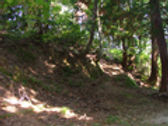
This is what the Tenguyama hiking trail looks like.

Ubagon-gen.
As this is a sacred mountain, women were not allowed to climb it in the past.
Now, it is permitted.

Arrival at the Inner Sanctuary (Okunoin).
Swords have been dedicated here.

One of Iide Town’s representative landscapes: the dispersed settlements.
On a clear day, you can overlook the entire Okitama area.

An autumn scene.

Yay! We made it to the summit!
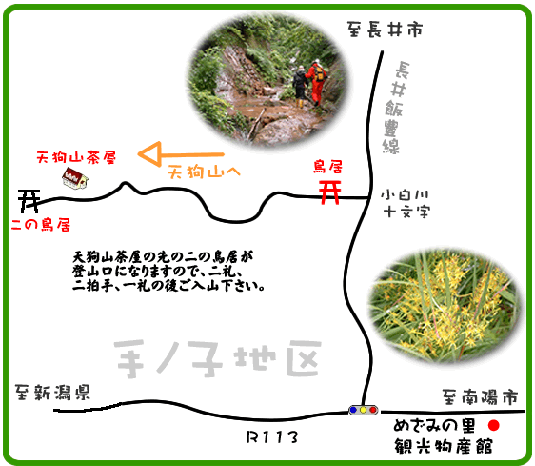
Course Description
Keimeikai Relics Hall and Butsunō Hall (Zairitsudō, Tsubaki, Iide Town)→ Torii Gate of Mount Tenguyama (Koshirokawa Jūmonji)
→ Bettō Hōzōin→ Tenguyama Teahouse / Second Torii Gate of Mount Tenguyama→ Child-Rearing Jizō→ Mikazuki Fudō→ Sacred Water (Gomadō)→ Ota-no-Kami→ Seishi Bosatsu→ Daikokuten / Kokūzō Bosatsu→ Daimyōjin→ Monju Bosatsu→ Kōshin / Mountain Deity→ Uba Gongen→ Ao-so Gongen→ Inner Sanctuary (Okunoin)→ Kaminari Gongen
Guide to Mount Tenguyama
Mikazuki Fudō
Mikazuki Fudō is enshrined beside a waterfall basin approximately 7 meters in height.
According to Buddhist records, it was enshrined in 1189 (the 5th year of Bunji) as a divided spirit of Sugaya Fudōson located in present-day Shibata City, Niigata Prefecture, by Gonen Shōnin, an uncle of Minamoto no Yoritomo.
The name “Mikazuki (Crescent Moon) Fudō” comes from the fact that a deeply devout believer named Kichizō Ono of the Shichiuemon family carved a crescent moon and donated it.
The water of the waterfall basin has long been believed to be effective for curing eye diseases.
Child-Rearing Jizō
This statue was donated with prayers for being blessed with children and for the healthy growth of children.
Gomadō (Goma Hall)
Since the hall was first built in 1894, it was renovated for the first time in 1923 and for the second time in 1975, remaining in its current form today.
At the center is enshrined the true image of Mount Tenguyama and Fudō Myōō, with a pair of tengu deities enshrined on either side.
Located at the center of the entire mountain, it was dedicated as a place for prayers and as a resting place.
Seijōsui (Pure Water)
This water is said to wash away the impurities of worldly desires.It has continued to spring forth unchanged from the past to the present.Water temperature: 8–9°C.
Ota-no-Kami (Rice Field Deity)
Enshrined at the base of a large cedar tree, this is an agricultural deity worshipped for abundant harvests of the five grains.
Dai-Seishi Bosatsu (Mahāsthāmaprāpta Bodhisattva)
The light of wisdom shines strongly, illuminating all things and possessing great power to free people from delusion.
Because of the emphasis on strong willpower, this deity is called Dai-Seishi (Great Strength Attainment).
Daikokuten
A deity of divine virtue, wealth, martial strength, and protection of the kitchen.A god who bestows abundant harvests and prosperity.
Kokūzō Bosatsu (Ākāśagarbha)
Worshipped as a Buddha of wisdom, learning, and good fortune.
Inari Daimyōjin
In farming villages, this deity governs the rice fields and mountains and is worshipped for abundant harvests.
In fishing villages, it is worshipped as a god of a bountiful catch and prosperity in business.
Monju Bosatsu (Mañjuśrī)
A Buddha of wisdom and learning.Abe Monju-in in Nara, Chion-ji at Amanohashidate, and Daishō-ji in Kameoka, Yamagata, are known as the Three Great Monju of Japan.
Kōshin-sama
A deity that drives away evil spirits that bring harm to people.
Mountain Deity
A god who protects and governs the mountains.It is believed that in spring the deity descends from the mountains to become the god of the rice fields, and after the harvest in late autumn, returns again to the nearby mountains.As a creator deity, it has been deeply worshipped by the people.
Aoso Gongen
During the era when women were forbidden to enter sacred mountains, there was a legend of a woman turning into stone.
There are said to be about 350 such sites across Japan, and according to scholars from Mito, many are enshrined in the Tohoku region.
Inner Sanctuary (Okunoin)
Located at an elevation of approximately 630 meters, Dainichi Nyorai is enshrined here.
Dainichi Nyorai is the central Buddha of Shingon Esoteric Buddhism, also known as Mahāvairocana Buddha, who embodies the essence of the entire universe.
The true nature of Dainichi Nyorai, the essence of all things, cannot be expressed through color or form.
However, because humans require form and color to understand, the Buddha is represented in a visible form.
Kaminari Gongen
Enshrined as the guardian deity of the entire Mount Tenguyama.
As the old stone shrine weathered over time, a new stone shrine (approximately 60 cm in height) made of fine granite was donated in October 1995 by volunteers from Koshirokawa.